
Atlantic Council


REGISTER

Get Email Updates

New Atlanticist
Printer-friendly version
Subscribe via RSS
Home :: International Security

Kissinger: Iran Diplomacy More Than Just Talk

James Joyner | January 16, 2009
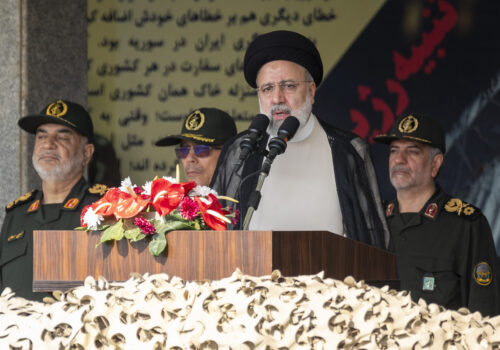
Mahmoud Ahmadinejad at UN Photo

Perhaps the longest running foreign policy argument during the 2008 presidential campaign stemmed from Barack Obama's vowing during the July 2007 YouTube debate that he would be "willing to meet separately, without precondition . . . with the leaders of Iran, Syria, Venezuela, Cuba and North Korea, in order to bridge the gap that divides our countries." He was beat up over this repeatedly, first by his erstwhile primary challenger and now Secretary of State-designate Hillary Clinton and then by Republican John McCain. I argued in "Preconditions, Preparations, and Posturing" that this was ultimately a debate over semantics, in that all three candidates had essentially the same policy.  We shall soon see.

This controversy was brought to mind last evening by a profound observation from Henry Kissinger, speaking to the Atlantic Council as part of our Christopher Makins lecture series.  In response to a question from Boston Globe foreign policy reporter Farah Stockman, who asked him for creative solutions to our nuclear standoff with Iran along the lines of the Nixon administration's opening to China, Kissinger quipped that they didn't simply hop on an airplane one day and begin talks.   Instead, it was "a three year project" that was "developed slowly and carefully."   The real breakthrough "did not come at the negotiating table" as a result of his considerable charm and diplomatic brilliance but rather in seeing the strategic opportunity three years earlier presented by the massing of 42 Soviet divisions on the Manchurian border.

Unfortunately, Iran does not have the same threat-based incentives at the moment.  For diplomacy to work, then, we must "create the circumstances" to convince them that "their present course will fail." To do that, we must extend the discussion beyond the issue of nuclear weapons to include other issues important to them. We must persuade them that "some of their objectives" are beyond their reach.

More fundamentally, Kissinger continued, we must ask ourselves a strategic question:  Can we accept Iran as a regional power?  He notes that, under the Shah, we did so for decades and saw it as in our interests.

Related New Atlanticist Commentary:

Related Event:

James Joyner is managing editor of the Atlantic Council. Photo from Getty Images.

Trackback URL for this post:

http://www.acus.org/trackback/2705

Comments

Post new comment

The content of this field is kept private and will not be shown publicly.
  • Web page addresses and e-mail addresses turn into links automatically.
  • Allowed HTML tags: <a> <em> <strong> <cite> <code> <ul> <ol> <li> <dl> <dt> <dd><a> <p> <span> <div> <h1> <h2> <h3> <h4> <h5> <h6> <img> <img /> <map> <area> <hr> <br> <br /> <ul> <ol> <li> <dl> <dt> <dd> <table> <tr> <td> <em> <b> <u> <i> <strong> <font> <del> <ins> <sub> <sup> <quote> <blockquote> <pre> <address> <code> <cite> <embed> <object> <strike> <caption> <swf> <swf list>
  • Lines and paragraphs break automatically.
  • Flash node macros can be added to this post.

More information about formatting options

CAPTCHA
This question is for testing whether you are a human visitor and to prevent automated spam submissions.
4 + 4 =
Solve this simple math problem and enter the result. E.g. for 1+3, enter 4.

New Atlanticist Navigation

Recommended Blogs

Global Leadership Circle